
Read Baldwin County Tax Fields by Office
Two offices split the work behind Baldwin County property tax records. The assessor handles valuation while the commissioner collects, so never treat an assessor value page as the payment ledger.
| Field | What It Shows | Where |
|---|---|---|
| Fair-market value | County estimate of full value for the tax year | Board of Tax Assessors |
| Assessed value | Georgia's taxable assessment base, generally 40% of fair-market value | Board of Tax Assessors |
| Class and exemptions | Tax classification and approved homestead or special treatment | Board of Tax Assessors |
| Bill and payments | Gross tax, payments, balance, penalty, interest, and delinquency | Tax Commissioner |
| Tax lien/FIFA | Recorded consequence of unpaid tax when applicable | Tax Commissioner and Clerk |
Sale price is deed evidence, not assessment input. Georgia's formula starts with fair-market value. Multiplying it by 0.40 yields assessed value, and millage applied to that figure produces the tax before exemptions, credits, fees, and special assessments.
Baldwin's January 1 Assessment Snapshot
The Baldwin Board of Tax Assessors values each parcel as it stands on January 1. The same office builds the annual digest, processes returns and exemptions, and keeps real-property records with photographs. Permits, appeals, sales, and manufactured homes feed its work. That single date explains a familiar confusion. A December closing and the property card can disagree simply because the snapshot came first. Recording, GSCCCA indexing, assessor updating, and billing run on separate tracks, so keep the tax year and source date with every figure. The qPublic landing page publishes no fixed refresh schedule. An assessor card is not live title evidence.
Assessor and Tax Commissioner Have Different Answers
Assessment questions go to the Board at 1601 N. Columbia Street, Suite 120, Milledgeville, or 478-445-5300. The Board answers valuation and exemption calls. Bill, payment, delinquency, and collection questions take a different door. Tax Commissioner Cathy Freeman Settle works from Suite 100 in the same complex at 478-445-4813, Monday through Friday, 8:30 a.m.–4:45 p.m., except holidays. For written background, the Tax Commissioner's property guidance explains the Georgia assessment relationship, returns, exemptions, appeals, and mobile-home rules.
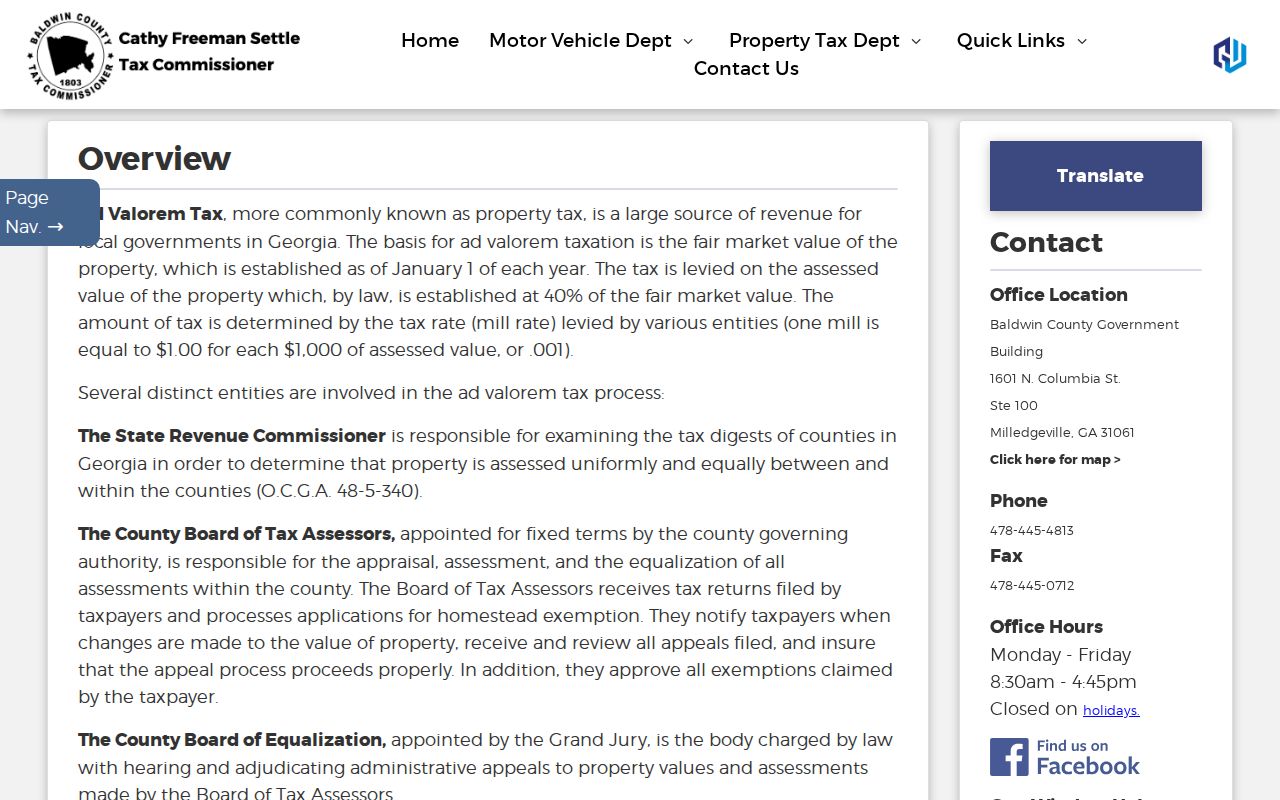
The policy page explains how Baldwin County builds its definitions. For the actual tax bill amount and payment status, pull the record for that year.
Look Up a Baldwin County Tax Bill
The Government Window tax endpoint is Baldwin County's official online route for searching and paying a tax bill. Field labels on the payment form vary by year. Have the qPublic parcel number ready when possible. Otherwise keep the situs address, the owner as listed for the tax year, and the bill year at hand.
- Resolve the address to the exact Baldwin parcel and choose the correct tax year.
- Read gross tax, payments, balance, penalty, interest, and delinquency as separate fields.
- Compare the class and exemptions to the assessor record for the same year.
- Follow a lien/FIFA reference to the Clerk and confirm any sale information independently.
- Assessed value
- The taxable assessment base, generally 40% of fair-market value in Georgia.
- Mill
- One dollar per $1,000 of assessed value, expressed as .001.
- Homestead exemption
- Approved relief tied to a qualifying owner-occupied legal residence.
- Tax lien/FIFA
- A recorded claim associated with unpaid property tax; verify status and release.
Office, mail, and drop-box channels also work. Card convenience fees run 2.57% for Discover, MasterCard, and Visa, and 3% for American Express with a $1.50 minimum. Confirm fees on the current page before paying.
Verify Baldwin Tax Dates Each Year
Baldwin County's official pages give two different due dates. The Tax Commissioner homepage lists 2025 real-property bills as due December 15, 2025, and marked past due. The general tax-bill information page says bills are generally due November 15. Neither wins on its own. Trust the date printed on that year's bill. Call the Tax Commissioner about any mismatch before relying on either page. The same guidance adds practical rules. Mail counts if postmarked by the due date, two payments are allowed, and a drop box is available. A lien is its own hazard. A recorded tax lien, or FIFA, can stay in the January 1 owner's name unless a closing statement reaches the office within 90 days after the due date, and the official Baldwin bill-information page explains mailing, due dates, penalties, and lien consequences.
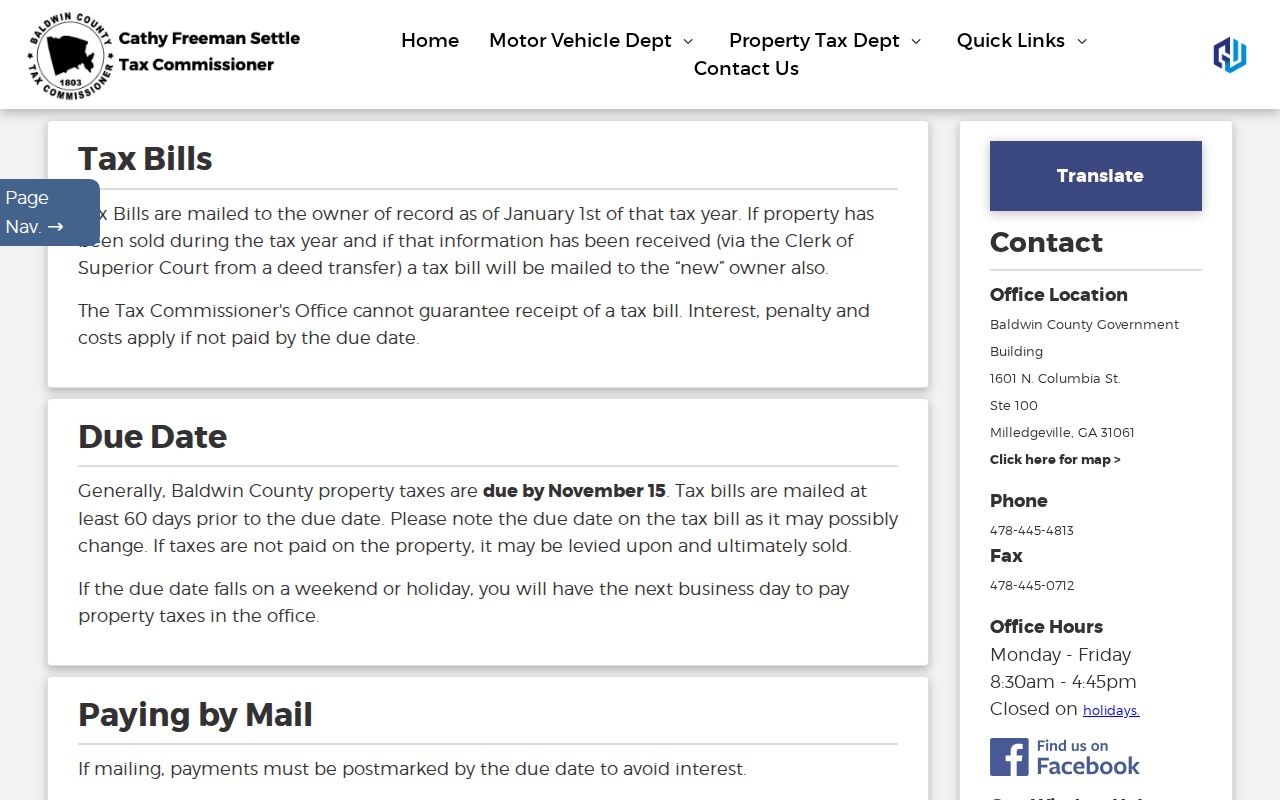
Still reconcile that general date with the year's actual bill.
Homestead and Specialized Baldwin Classifications
Homestead in Baldwin County applies to a qualifying owner-occupied legal residence. Ownership and occupancy must both exist on January 1. First-year filing generally closes April 1, and the exemption renews unless ownership, residence, or eligibility changes. The flag signals tax treatment only. It does not prove title or continuous occupancy. Other programs carry their own rules: agricultural valuation, Conservation Use Value Assessment, Forest Land Protection Act covenants, historic-property provisions, and brownfield treatment. Each sets distinct eligibility and commitment terms. A resident 62 or older may defer homestead tax when gross household income stays at or below $15,000, subject to statutory deferred-balance conditions. Verify current terms before counting on one.
Mobile Homes Follow an April 1 Cycle
Mobile-home bills in Baldwin County follow an April 1 cycle, per the Tax Commissioner homepage. The real-property due date does not transfer. Mobile homes carry separate tax, decal, penalty, and appeal mechanics. Match the decal or identifying information, the bill year, and the location before comparing records. Keep the property class identified early in any search. A manufactured-home inspection, return, or permit can also create an assessor record event. That event differs from a conventional deed transfer.
Read Delinquency and Tax-Sale Clues Carefully
A delinquent amount can appear on a tax roll as a penalty or a FIFA entry. That is a clue. It is not proof that a tax sale happened. Confirm the balance and payoff figure with the Tax Commissioner first. Then check the Clerk's deed records for the lien and any release. A levy or sale may have been advertised. Write down the parcel number, the January 1 owner of record, the legal description, the sale date, and the office handling it. Those details anchor everything that follows.
Court dockets and public notices can shed light on a dispute. A party's name alone, though, does not tie a case to land. Match the property description. Follow the file through to its end, whether that is cancellation, confirmation, a redemption event, or a deed. Never treat a stale delinquency notice as evidence of who owns the parcel today.
Appeal a Baldwin County Assessment Notice
Baldwin County owners can appeal taxability, value, uniformity, or exemption. The window is 45 days from the assessment notice. That deadline is strict. Save the notice itself and the envelope, plus your filing confirmation, the parcel number, the property description, value history, photographs, comparable sales, repair estimates, and any independent appraisal you obtained. File with the Board of Tax Assessors using the route printed on the notice.
From there, an appeal can move to the Board of Equalization. Nonhomestead real property assessed at $1 million or more may qualify for a hearing-officer route. Arbitration calls for a certified appraisal. It is described as producing a final decision with no further appeal. A Board of Equalization decision can still be appealed to Superior Court.
Appeal window. Baldwin County assessment appeals must reach the Board within 45 days of the notice; preserve proof of timely filing and follow the notice's current instructions.
The county's 2025 performance review flagged quality-control and audit problems with frozen-homestead parcels and older freeze conversions. That makes it worth noting the source date on any record. Question an unexplained freeze or conversion, but do not assume a specific record is wrong.