
Baldwin Former-Owner Timelines Start With Deeds
Build the timeline first. Record the date, parties, instrument, and citation for every transfer. No name belongs on a former-owner timeline until the parcel or legal description ties that deed to the subject land.
| Transfer date | Grantor to grantee | Deed type | Book/page or source |
|---|---|---|---|
| Newest confirmed filing | Prior owner to current grantee | Read the instrument itself | Clerk or GSCCCA citation |
| Earlier filing | Earlier owner to that prior owner | Confirm conveyance status | Earlier book/page |
| Before online reach | Names from reverse index and deed books | Historic conveyance | Clerk book or archive microfilm |
| Early-land era | Grant, survey, estate, or adjoining-owner clues | Grant, deed, probate order | Archives, DLG, or FamilySearch |
GSCCCA is the practical modern start for deed records. Older owners may require the Clerk's books, Georgia Archives county cards, the Virtual Vault, DLG, or FamilySearch.
Reconstruct Baldwin County's Deed Chain Backward
Reverse-chain work is simple in concept. Each deed becomes the query for the deed before it, and book/page, parcel, and legal-description continuity, not names alone, makes the sequence credible.
- Find the current owner's acquiring deed, with that owner shown as grantee.
- Copy the grantor, filing date, instrument type, book/page, and full legal description.
- Search that grantor as a grantee in an earlier period, including initials and fiduciary or entity variants.
- Match the earlier deed to the same lot, section, acreage, plat, or parent tract.
- Repeat until the references leave the online index, then continue in the older books or films.
- Grantor and grantee
- The conveying party and receiving party named in the deed.
- Chain of title
- The ordered sequence of instruments affecting the parcel.
- Reverse index
- An index organized to help find the deed by the receiving party.
- Quitclaim and warranty deed
- Different conveyance forms whose legal effect must be read from the instrument.
Baldwin Former Owners Before the Online Baseline
GSCCCA states that its statewide deed index covers all counties since at least January 1, 1999. Historical data is continually added. Treat that date as a baseline only. It does not prove every Baldwin image begins in 1999. It also does not prove that nothing older is online. Test the earliest local result and note whether an image appears.
Time-depth limit. When the Baldwin County online chain stops, continue with Clerk deed books, reverse indexes, Georgia Archives county cards, and microfilm rather than declaring the chain complete.
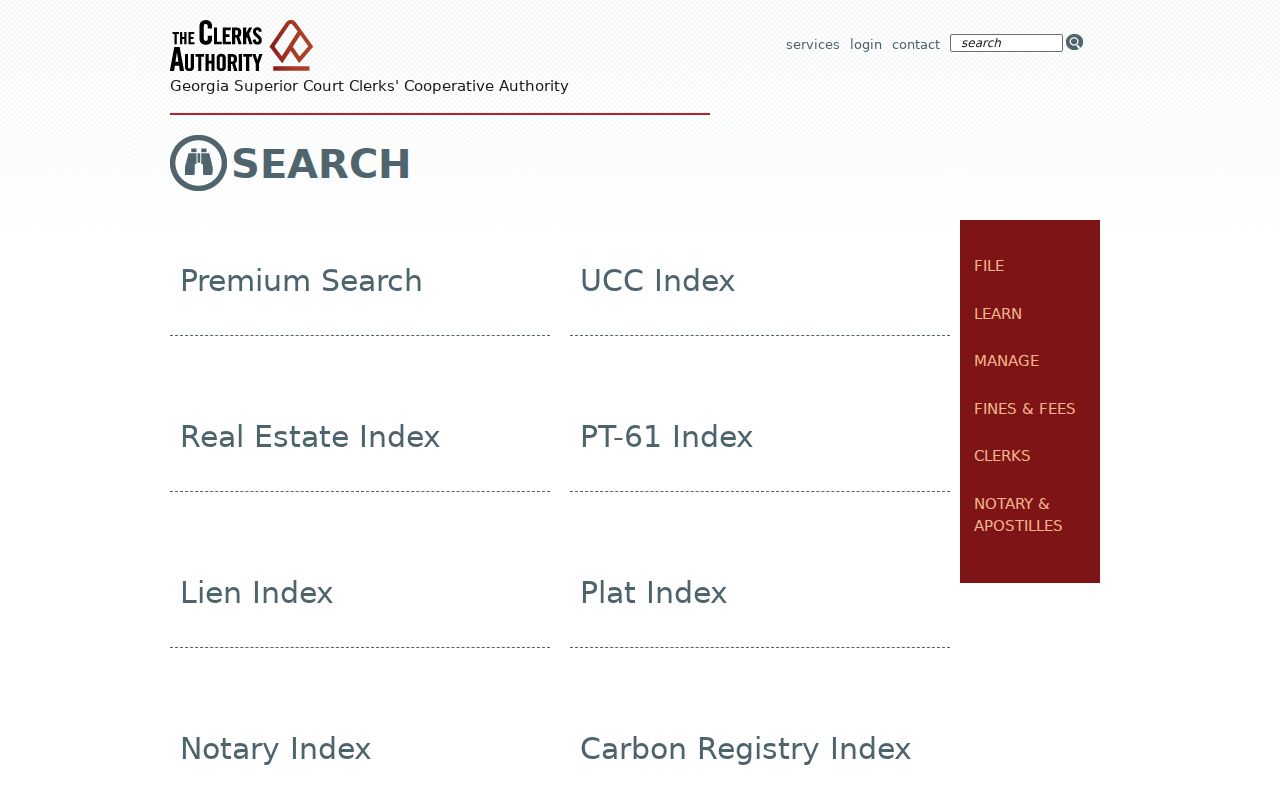
The official GSCCCA search hub is shown below. Account and image access depend on the current service terms.
Not Every Baldwin Deed Hit Changed Owners
A grantor or grantee search returns far more than conveyances. Hits can include warranty deeds, quitclaim deeds, security deeds, assignments, releases, easements, rights-of-way, liens, plats, corrections, and other instruments. Classify every hit before it enters the former-owner timeline.
A release may clear a lien. A correction may fix an earlier document. A plat can define lots without conveying them, and even a true conveyance must match the subject legal description. When a street address is missing, search adjoining references and prior-deed citations.
Note: Book/page and legal-description continuity are stronger chain anchors than a repeated surname or unchanged street address.
Capital-Era Lots Complicate Baldwin Former Owners
Baldwin County was organized in 1803. Milledgeville was laid out that same year. The town served as Georgia's capital from 1804 to 1868. Its land trail reflects that era.
Capital-era deeds rarely name a modern street address. Instead they describe a ward, a lot, or a square. They may cite a public building, an adjoining owner, or an institution. Pair that old wording with a historic plat, the deed book, and the ward or block. Add the institution name and the later legal description. The National Register district nomination and DLG city laws can provide context. The recorded deed remains the ownership evidence. A modern address may not map straight back to a pre-1868 description.
Probate Bridges Missing Baldwin Prior Owners
A death often sends the ownership trail through probate first. Look for the will, letters appointing an executor or administrator, the inventory, a petition and order to sell land, the distribution, and the fiduciary deed. Compare each file's land description with the deed chain.
The Georgia Archives finding aid for Baldwin Probate Court Bench Dockets covers 1827 through 1872. It describes land-sale petitions, administrators, guardians, and judgments. It can explain the authority behind an old transfer. It still does not replace the deed that conveyed the parcel.
Where Baldwin County's Older Ownership Chain Lives
The Georgia Archives county-card catalog is the best first check for surviving filmed county series and custody. Its general warning is blunt. Post-1900 microfilm is limited, and survival varies after disasters. No official source documents a Baldwin courthouse fire or a specific destroyed book run. Skip that story when a gap appears.
Early evidence lives in the Clerk's books and indexes, the Georgia Archives, DLG, FamilySearch, and the Virtual Vault. Digitized examples include an 1805 Baldwin land deed and plat, an 1805 grant and survey, and an 1836 indenture. A book/page citation makes the request simple. Ask the Clerk for the volume and copy route.
Depth of Baldwin Previous-Owner Evidence
The earliest trail may reach state land grants, surveys, headright or bounty material, deed books, and probate records. It may also stop cold. An index runs incomplete, a legal description changes, or a parent tract splits. State the last confirmed former owner and the source. Never bridge a gap with a guess.
Lawful use. Trace Baldwin County prior owners for house history, estate work, title research, or purchase diligence. Never use the chain to track, target, or harass a living person.
A contested chain calls for a qualified title professional. For one recorded instrument or a certified copy, the Baldwin County deed records guide walks through the Clerk and GSCCCA access routes. Keep a research log as the chain grows. At every step, record the query, name variant, county, date window, instrument class, book and page, image availability, grantor, and grantee. Note whether the legal description matches. Treat a correction, release, mortgage, easement, plat, or lien as context. Do not force it into the transfer timeline. When one deed cites an earlier deed, copy that citation exactly. Test it before running another broad name search.
At the Clerk counter or by phone, lead with the book and page if you have it. Otherwise give both parties, an approximate year, a subdivision or acreage clue, and the current or parent parcel number. Ask which deed books, reverse indexes, or films cover that span and what copy options apply. The Clerk publishes no complete ordinary and certified-copy fee schedule online. Confirm current charges before requesting a large run.
Archive requests work the same way. Use the Georgia Archives county-card catalog to identify a series, then ask about the specific volume or reel. DLG and Virtual Vault add digital context, while FamilySearch availability varies. Cite the repository and image or film reference in your timeline. That audit trail lets the next researcher tell a confirmed owner of record from a plausible same-name lead.
Close the timeline with a confidence note. State whether each link rests on a recorded conveyance, probate authority, plat reference, tax-roll clue, or contextual source. If a woman's surname changed, show the variant. If an entity absorbed another, show the variant too. The same goes for an executor who signed in a fiduciary role. Never merge identities. If acreage or adjoining-owner calls shift, pause. Test whether the chain jumped to a parent tract or only part of the land.